Image Recognition in Surgical and Diagnostic Mobile Apps: A Transformative Future for Healthcare
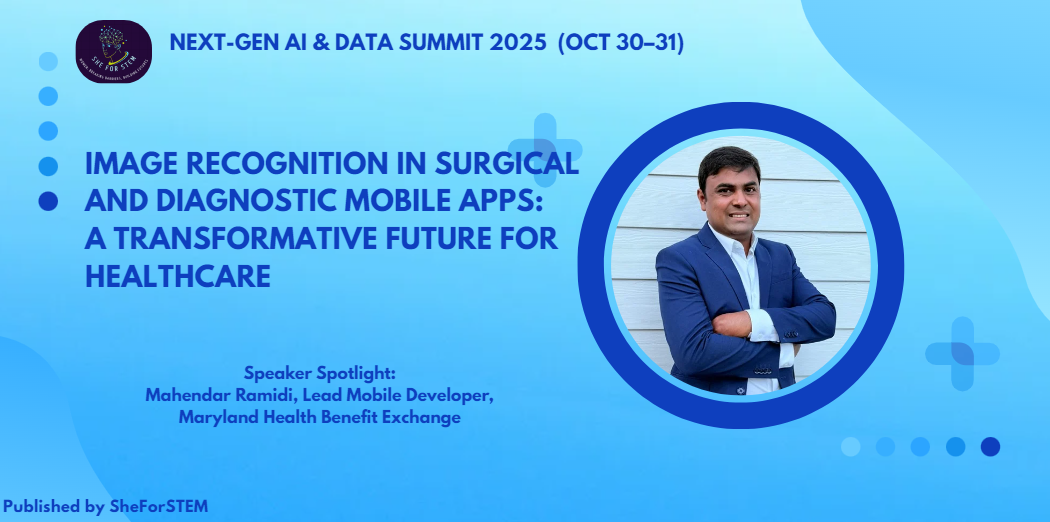
Speaker Spotlight: Mahendar Ramidi, Lead Mobile Developer, Maryland Health Benefit Exchange
Introduction
In today’s rapidly evolving digital health landscape, mobile technologies have moved far beyond convenience—they now serve as critical enablers of precision medicine. Artificial Intelligence (AI), particularly image recognition, is driving a new era of accuracy, speed, and safety in healthcare diagnostics and surgeries.
At the SheForSTEM Expert Series, we had the privilege of hosting Mahendar Ramidi, a highly accomplished technologist with over 11 years of experience building secure, enterprise-grade mobile solutions for healthcare, government, and aviation systems. Mahendar currently serves as a Lead Mobile Developer at the Maryland Health Benefit Exchange. His work spans clinical decision support solutions, telehealth platforms, patient engagement apps, and high-security authentication systems. His innovations have supported national healthcare systems, including projects for the National Institutes of Health (MySTORI Platform), the Maryland Department of Health, United Airlines, and the Department of Human Services. His contributions have improved patient safety, reduced fraud, enhanced mobile health accessibility, and received recognition from ASCO and state-level health authorities. Beyond engineering, he mentors developers, leads Agile teams, and integrates modern DevOps pipelines for scalable healthcare solutions.
His session, “Image Recognition in Surgical and Diagnostic Mobile Apps,” offered a rare, hands-on exploration of how AI is reshaping clinical workflows—from the moment a patient enters an operating theatre to the postoperative analysis that determines surgical success.
The Rise of Mobile Image Recognition in Medicine
Mahendar began by highlighting a powerful industry shift: By 2024, mobile medical image recognition crossed a $14 billion market size, processing speeds now reach 1 million operations per second, and clinical time reduction has improved by nearly 50% in many diagnostic workflows. Radiologists, surgeons, and clinicians increasingly rely on mobile devices as real-time diagnostic companions. What once required large workstations or specialized imaging equipment is now happening on smartphones and tablets.
“Today, the phone in a radiologist’s pocket can process and classify medical images with remarkable accuracy—often in seconds.” — Mahendar
A Real-World Innovation: Surgical Implant Verification Using AI: One of the most impactful solutions Mahendar developed during his federal healthcare work was an AI-powered mobile system for surgical implant verification.
The challenge (before AI): In operating rooms, surgical tools and implants are arranged on trays before and after a procedure. Manually verifying whether every implant is accounted for is time-consuming and prone to human error. Miscounts can lead to serious risks—including unintentional retention of surgical items.
Mahendar’s solution: A mobile app that allows staff to: Capture a photo pre-surgery, Capture another post-surgery, Automatically compare both images using deep learning, Detect missing implants, and Flag discrepancies and attach them to patient surgical records.
This solution enabled - Near-instant implant verification, reduction in surgical errors, traceability of implants beyond the traditional 7-year documentation limit, improved patient safety, and significant operational efficiency. This single innovation demonstrates how image recognition is not just a “tech boost” but a critical component in safe surgical practice.
Deep Learning Engines Behind the Technology: Mahendar explained how image recognition systems rely on:
- AI-powered segmentation and classification: Models trained on thousands of implant tray images to ensure high accuracy.
- Explainable AI: To build surgeon trust by making predictions transparent and interpretable.
- Federated learning: Allowing models to improve across institutions without sharing sensitive patient data.
- Robust hardware + software synergy: High-resolution cameras; TensorFlow / PyTorch models; Cloud platforms; DICOM-based medical imaging standards; and Secure APIs for HIPAA-compliant data exchange.
These layers ensure that image recognition apps remain fast, secure, and clinically reliable.
- Clinical Applications Across Specialties: Mahendar demonstrated how mobile image recognition is already transforming:
- Radiology & Diagnostics: Smartphone imaging integrated with AI improves the detection of abnormalities, skin lesions, tumors, and physiological changes.
- Surgical Workflows: Real-time mobile imaging helps verify implants, reduce surgical time, and enhance intraoperative safety.
- Ophthalmology: Case studies of smartphone-based eye tumor screening achieved: 87% accuracy; F1 scores around 0.87; and Smartphone-based detection with high clinical reliability.
- Remote & Preventive Care: Apps like MySTORI enable cancer patients to scan symptoms daily and send data directly to clinicians.
This supports personalized treatment plans and early detection of complications.
Challenges: What Holds Back Real-Time Mobile Image Recognition?
Mahendar highlighted the key barriers: Variability in image quality (lighting, camera resolution); Need for large and diverse datasets; Heavy regulatory approval frameworks (HIPAA, FDA, EMA); and Integration challenges with hospital systems/legacy infrastructure. However, every challenge is solvable—and innovators like Mahendar are doing just that.
Breakthroughs & Strategies to Overcome Barriers: The next wave of innovation:
- Federated learning models - To protect privacy while improving accuracy across hospitals.
- Lightweight models - Optimized for phones and tablets without sacrificing precision.
- Continuous model retraining - Using real-world data to keep models clinically relevant.
- User-friendly, clinician-centered app design - Because surgeons must be able to use these apps seamlessly during procedures.
Impact: Faster Diagnosis, Fewer Errors, Better Outcomes
Mobile AI systems have demonstrated: 3× faster diagnosis; 74% reduction in human error; 75% increase in patient throughput; and 28% decrease in overall cost. For many hospitals, these numbers translate to fewer complications, improved survival rates, and better clinical workflows.
Future Directions: Where Are We Headed? Mahendar outlined exciting possibilities:
- AR-Assisted Surgeries: Overlaying implant recognition in real-time.
- Robotics Integration: Using AI to guide robotic surgical systems more precisely.
- Fully Integrated OR Workflows: Digitizing every step of a procedure end-to-end.
- Ethical & Privacy Standards: Ensuring transparency, consent, and bias-free training data.
A Global Vision: Making Healthcare Equitable
One of the most inspiring insights from Mahendar was the global impact of mobile diagnostics:
- Smartphones make high-quality diagnostics accessible even in rural and underserved regions.
- Emergency cases can be triaged immediately using mobile imaging.
- Patients gain the ability to self-monitor blood pressure, glucose, lesions, wounds, and symptoms using AI-enhanced apps.
This democratizes healthcare and narrows the global healthcare inequality gap.
Conclusion: A Future of Smarter, Safer, More Accessible Healthcare
Mahendar closed his session with a powerful message: “AI-driven mobile image recognition isn’t just a technological upgrade—it’s a revolution in precision medicine and patient-centered care.”
From surgical safety to ophthalmology, from cancer care to emergency response, mobile AI tools are transforming healthcare delivery. As innovators, developers, researchers, and clinicians continue to collaborate, the future promises: More accuracy; More patient safety; More accessibility; And a truly data-driven healthcare ecosystem.
SheForSTEM celebrates leaders like Mahendar Ramidi who are shaping this future with expertise, vision, and an unwavering commitment to innovation.
